23 OCTOBER · 18:00 ISTANBUL · YOUTUBE PREMIERE
Aşk Bezirgânı (Ateş Versiyonu)
Words: Yunus Emre
Interpretation: Sûfî Ayna
Yunus Emre’s verses become a state of fire through soaring male voices, deep bass and psychedelic rock. The couplets move through surrender for love, the worth concealed beneath appearances, and the cost of speaking the truth. “You burned me in the fire and scattered my ashes / Is this how you should treat the one who loves you?” rises from the intensity as a plea to the Beloved.
Friday 23 October 2026, 18:00 Istanbul (15:00 UTC). Set a reminder on the Premiere page.
Turkish lyrics, English translation & poetry notes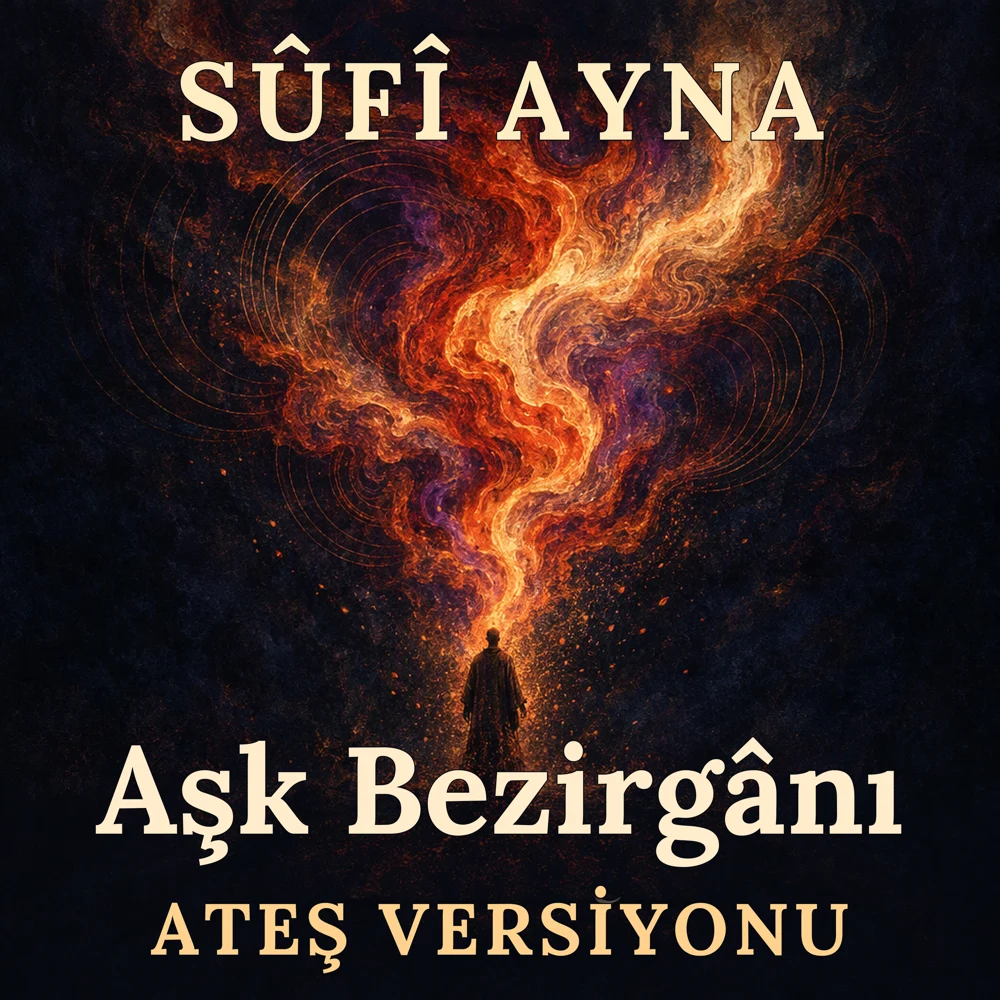
Turkish lyrics · Couplet form
The nine couplets used in this interpretation, without musical repeats.
English translation · Meaning-based
A SHORT READING
The fire of love and the cost of truth
Each couplet keeps its own form, meaning and emotional character. Ibrahim Adham’s exchange of satin for rough cloth evokes renunciation; Jesus and Korah embody contrasting attitudes towards the world.
The tension around Mansur’s utterance intensifies in the plea, “Is this how you should treat the one who loves you?” In the final couplet, Yunus returns to the cost of saying what one has seen. Fire carries both love’s consuming force and the danger of speaking the truth.
This interpretation uses a different composition from Aşk Bezirgânı on the earlier album.
Where the words begin
Poem: Yunus Emre. The nine couplets used in the Fire Version are presented in their couplet form.
Consulted poem transcription ↗
Attribution & text notes
Musical repeats are omitted from the reading text. Spellings follow the wording chosen for this interpretation; historical editions differ. The English is a meaning-based translation of this text. The source link leads to Mustafa Tatcı’s Diyanet edition; this page is not a verbatim transcription of that edition.
Words within the verse
- Himmet.
- Spiritual support and resolve.
- Palas.
- Rough cloth, associated here with renunciation of outward splendour.
- Ene’l Hakk.
- “I am the Truth”, attributed to Hallaj (Mansur); Hakk is a divine name.
- Kaarun.
- Korah, associated with wealth and attachment to the world.